 Image 1 of 1
We have become astonishingly powerful.
We have not yet decided what all that power is for.
Artificial intelligence can increasingly write, reason, calculate, imitate, persuade, create, and remember. Our technologies are accelerating faster than our institutions, our attention, and perhaps our wisdom. We possess capabilities that earlier civilizations would have mistaken for the powers of gods while remaining vulnerable to the oldest human failures: pride, appetite, fear, faction, loneliness, cruelty, self-deception, and the hunger for meaning.
The Human Renaissance begins with a wager:
The decisive question of the age of machines is not what machines will become.
It is what human beings will become beside them.
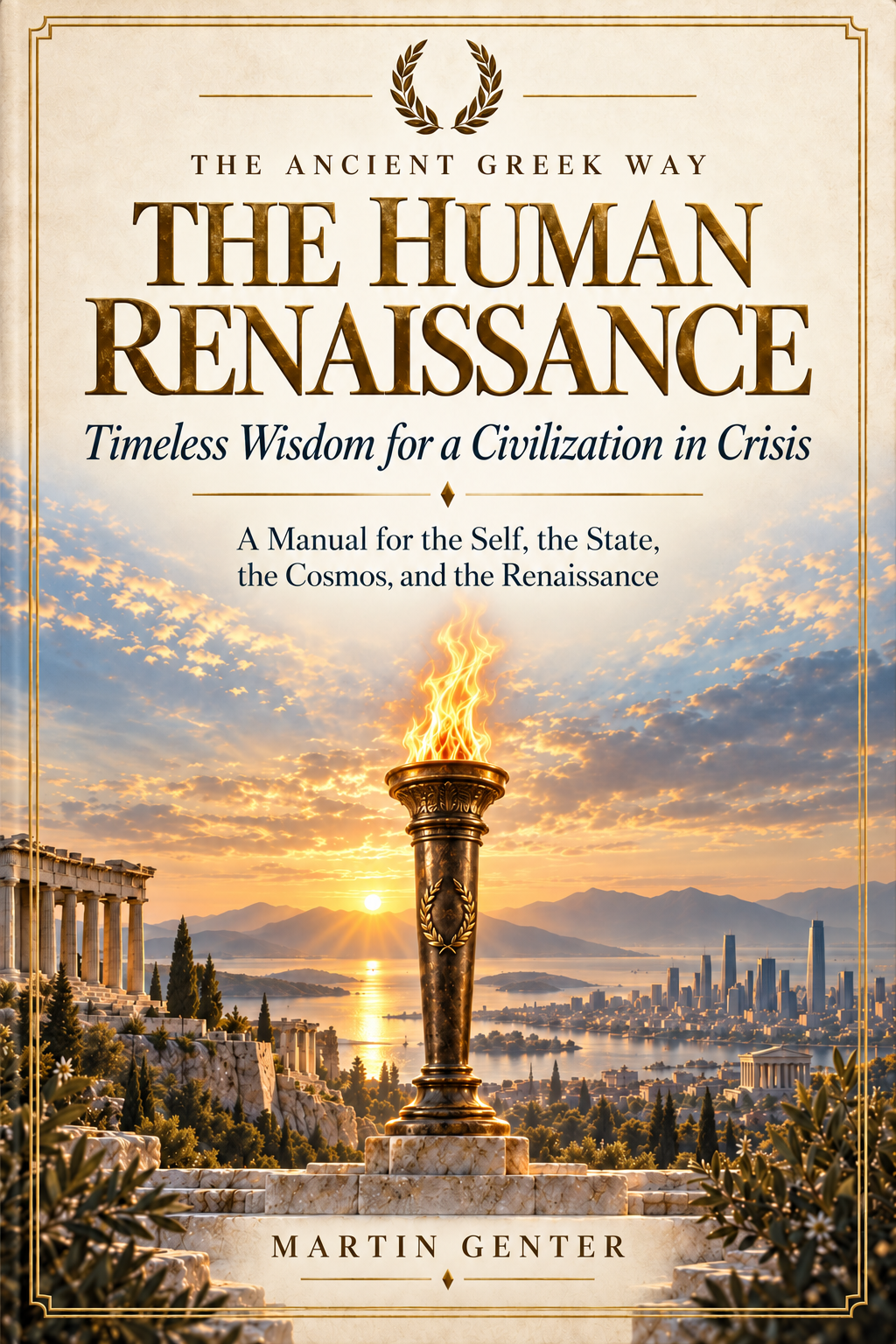
Across 120 concise, illustrated meditations, Martin Genter returns to the civilization that first confronted many of these questions with unusual clarity. Socrates asks whether a life can be examined honestly. Aristotle asks what human flourishing requires. Homer asks what rage, loyalty, homecoming, and mortality do to us. Greek tragedy asks what happens when power exceeds wisdom. The polis asks what citizenship demands. The night sky asks where humanity belongs in a cosmos far larger and stranger than our ancestors could have imagined.
But this is not an escape into antiquity.
Ancient Greece becomes a lens through which to examine the most urgent problems of the present: attention and addiction, character and ambition, friendship and loneliness, rhetoric and manipulation, democracy and faction, leadership and power, science and meaning, artificial intelligence and stewardship, mortality and transcendence.
The journey unfolds through four great questions:
How shall I govern myself?
How shall we govern ourselves together?
What kind of world have we awakened inside?
And what shall we do with what we have inherited?
The result is part philosophy, part civic manual, part meditation on civilization, part illustrated book of formation.
Its argument is both ancient and radically contemporary:
A technological renaissance without a human renaissance will not be enough.
The future does not merely need smarter machines.
It needs deeper human beings.
We have become astonishingly powerful.
We have not yet decided what all that power is for.
Artificial intelligence can increasingly write, reason, calculate, imitate, persuade, create, and remember. Our technologies are accelerating faster than our institutions, our attention, and perhaps our wisdom. We possess capabilities that earlier civilizations would have mistaken for the powers of gods while remaining vulnerable to the oldest human failures: pride, appetite, fear, faction, loneliness, cruelty, self-deception, and the hunger for meaning.
The Human Renaissance begins with a wager:
The decisive question of the age of machines is not what machines will become.
It is what human beings will become beside them.
Across 120 concise, illustrated meditations, Martin Genter returns to the civilization that first confronted many of these questions with unusual clarity. Socrates asks whether a life can be examined honestly. Aristotle asks what human flourishing requires. Homer asks what rage, loyalty, homecoming, and mortality do to us. Greek tragedy asks what happens when power exceeds wisdom. The polis asks what citizenship demands. The night sky asks where humanity belongs in a cosmos far larger and stranger than our ancestors could have imagined.
But this is not an escape into antiquity.
Ancient Greece becomes a lens through which to examine the most urgent problems of the present: attention and addiction, character and ambition, friendship and loneliness, rhetoric and manipulation, democracy and faction, leadership and power, science and meaning, artificial intelligence and stewardship, mortality and transcendence.
The journey unfolds through four great questions:
How shall I govern myself?
How shall we govern ourselves together?
What kind of world have we awakened inside?
And what shall we do with what we have inherited?
The result is part philosophy, part civic manual, part meditation on civilization, part illustrated book of formation.
Its argument is both ancient and radically contemporary:
A technological renaissance without a human renaissance will not be enough.
The future does not merely need smarter machines.
It needs deeper human beings.